c.1933 → 1970
The New
New Zealanders
Refugees, émigrés
and the making
of post-war New Zealand
They came looking for safety. Some of them changed the country that received them.
Europe, 1930s
- 01Berlin
- 02Vienna
- 03Prague
- 04London
- 05Palestine
- 06New Zealand
A country at the far end of the world begins to appear on European maps — as an option.
As Nazism spread through Europe, Jewish families searched for countries that would take them. New Zealand was remote and it was safe. It was not, however, easy to enter.
Some made it here anyway. They arrived carrying what could be carried, and a great deal that could not be packed.
What they found was a young country that could seem provincial, conservative and extraordinarily far from the Europe they had known. And they began again.
What arrived with them
- languages
- professions
- books
- European education
- memories
- trauma
- music
- architecture
- ideas
- recipes
- photographs
- different ways of seeing
The policy
Refuge —
with conditions.
Published scholarship — Ann Beaglehole's work above all — establishes that New Zealand admitted a relatively limited number of Jewish refugees from Nazi persecution. Entry was selective. Permits were rationed. Professional qualifications earned in Europe were frequently not recognised, and some newcomers were restricted in the work they could do.
Roughly a thousand fugitives from Nazism were admitted before 1939, most of them Jewish. Against the scale of what was happening in Europe, that is a small number, and many applications were refused.
This archive does not editorialise about that. It intends to document it: the policy, the correspondence, the individual files, the cases that succeeded and the cases that did not.
To be documented, with primary sources
- Immigration policy and permit categories
- Entry restrictions and guarantees required of sponsors
- Refugee numbers, year by year
- Government correspondence
- Individual applications — successful
- Individual applications — declined
- Family sponsorship chains
- Restrictions on professional practice
On the sourcesAnn Beaglehole’s A Small Price to Pay is the starting point. Immigration files at Archives New Zealand have not yet been examined for this archive.
They found
each other.
European Jewish refugees and émigrés in Auckland and elsewhere formed friendships, families and overlapping circles. Their houses became places for conversation, music, art, architecture, food, politics, books, European culture and Jewish memory.
This was not one organisation with a membership list. It was a network — which is harder to document and rather more interesting.
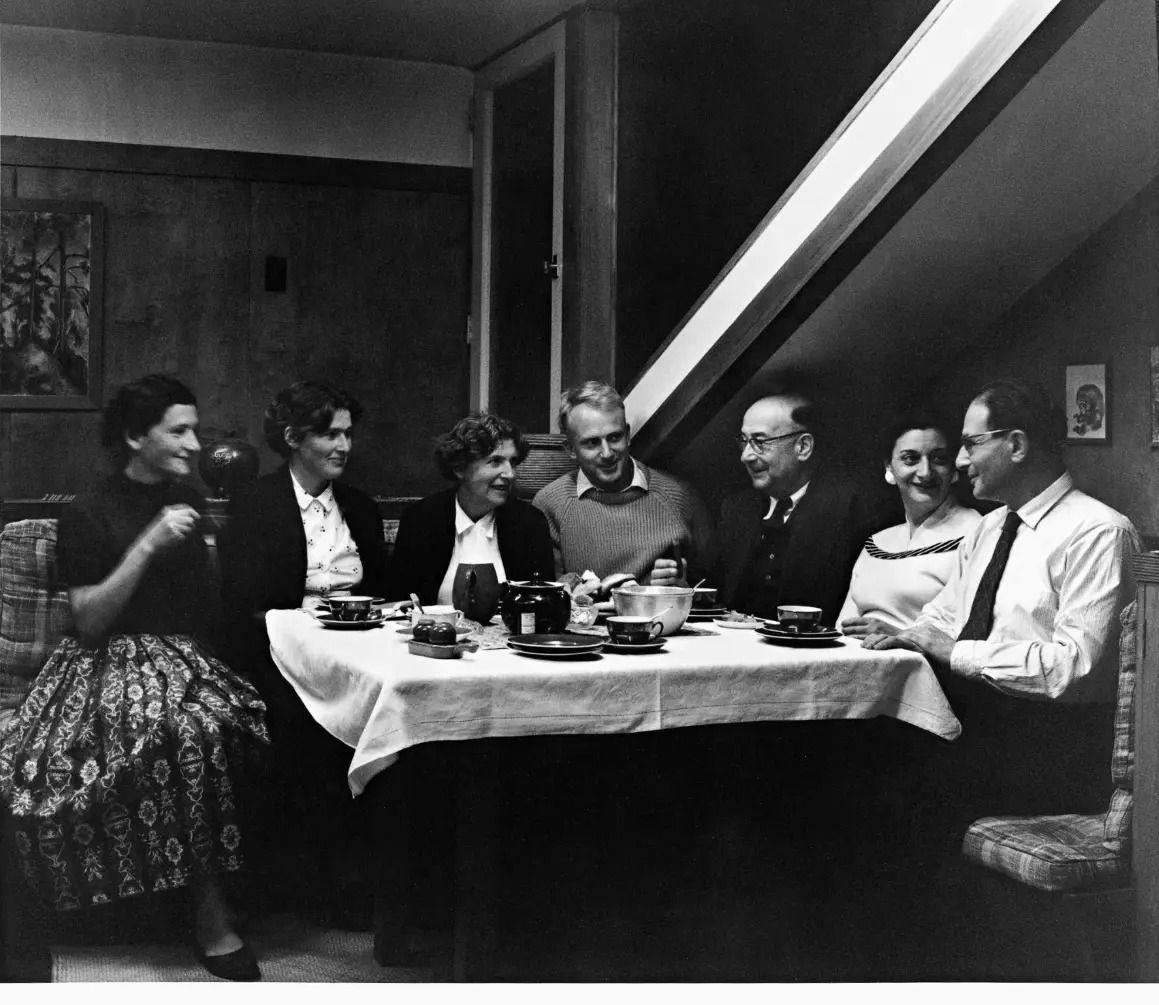
One evening in 1964, seven of them sat down to tea in a modernist house in Auckland, and someone at the table happened to be a photographer.
Marti Friedlander · Auckland · 1964
One photograph.
Seven lives.
Marti Friedlander · Auckland · 1964
Seven people around a table,
in a house designed by Henry Kulka.
Image withheld — rights permission pending from the Gerrard and Marti Friedlander Charitable Trust
Marti Friedlander (left), with Maru Kulka, Hilde Kulka, Gerrard Friedlander, Robert Fallek, Gisèle Schenirer and Henry Kulka, in a house designed by Henry Kulka, Auckland, 1964.Courtesy of the Gerrard and Marti Friedlander Charitable Trust
Photographed byMarti Friedlander1928–2016
Marti
Friedlander
Photographer. Jewish immigrant. Observer of New Zealand.
Marti Friedlander was born Martha Gordon in London's Jewish East End, the daughter of Russian-Jewish immigrants. She and her sister spent much of their childhood in a Jewish orphanage. She trained in photography in London, and in 1957 married Gerrard Friedlander, a New Zealander by adoption whose own family had fled Berlin.
In 1958 they moved to New Zealand. She found it unfamiliar — provincial, socially closed, a long way from the London she knew. Rather than quietly assimilating into it, she photographed it.
Artists. Writers. Children. Māori. Protest. Rural communities. Immigrants. Politicians. Ordinary people doing ordinary things in a country that was in the middle of changing and did not entirely know it yet.
The outsider's eye turned out to be the point. Her photographs are now part of the national record of what New Zealand looked like, and of how it came to understand itself.
She arrived as an outsider.She helped New Zealand see itself.
Editorial interpretation, not a quotation.
A collection in progress
New Zealand
through Marti’s eyes
As Friedlander photographs are cleared for use, they will be connected across this archive. Wherever one appears, it will carry its own small credit — photographed by Marti Friedlander — which opens her record.
Eventually including
- Jewish Auckland
- Artists
- Architects
- Political life
- Māori
- Social movements
- Immigrant life
- Urban Auckland
Only reproduced with appropriate permission or licence.
The archive of record
The Friedlander
Archive
A major archive of Marti Friedlander’s photographs, negatives and personal papers is held by Auckland Art Gallery Toi o Tāmaki, and is recognised on the UNESCO Memory of the World New Zealand Register.
We do not duplicate it. Our job is context and connection — the Jewish and émigré world the photographs came out of.
1900–1971
Henry
Kulka
Architect. Refugee. European modernist. New Zealander.
Henry Kulka's architectural education happened inside one of the central arguments of European modernism. He worked with Adolf Loos, and his thinking developed around Loos's spatial principles — most importantly the Raumplan, in which a house is composed as a set of interlocking volumes at different levels rather than as stacked flat floors.
After the Nazi annexation of Austria and the subsequent occupation of Czechoslovakia, Kulka and his family escaped Europe. He arrived in New Zealand in 1940.
He worked for Fletcher, becoming Chief Architect, and maintained private architectural work alongside it. Heritage New Zealand records that he designed more than fifty houses — many of them for fellow Jewish refugees.
That last detail is the whole chapter in miniature: European modernism, refugee migration, a Jewish social network and New Zealand domestic architecture, all arriving at the same address at the same time.
Vienna / Prague
- Vienna
- Prague
- Adolf Loos
- The Raumplan
- European interiors
Auckland
- Auckland
- New Zealand timber
- Climate and light
- Hillside sites
- Houses for new lives
Collection — in preparation
Houses
for a new life
A mapped record of Kulka-designed houses, with their clients where documented — a surprising number of whom were themselves refugees.
Private residential detail will not be published beyond what is already appropriately public through heritage listings and published scholarship.
Each house record will carry
- Address
- Date
- Client
- Architect
- Drawings
- Photographs
- Current status
- Heritage status
- Client biography
- Jewish / émigré connection, where documented
- Source
A story to be written
The photographer asks the architect to build a home.
Henry Kulka designed a house for Marti and Gerrard Friedlander in Herne Bay, Auckland, completed around 1967. Three of the people at the 1964 table, and one building that connects them.
Three more records
Gisèle Schenirer
Born Alexandria, Egypt. Jewish. Multilingual. Immigrant.
Not every post-war Jewish immigrant came from the same European world. Jewish New Zealand ran through Egypt, Italy, France and Britain as well as Berlin and Prague.
Gerrard Friedlander
Berlin → Palestine → New Zealand. Dentist.
Not simply “Marti’s husband”. A refugee with his own escape, his own profession, his own community life and his own philanthropy.
Robert Fallek
Research in progress.
Named in the 1964 caption, and nothing more is claimed. Origins, profession, immigration, family and community role are all open questions.
Who's who
The people
in the room
next door
The 1964 tea table is one room. Around it, in the same decades, was a whole generation of people who had arrived from Europe with an education, an accent and very little else, and who then quietly rebuilt New Zealand's intellectual and cultural furniture.
This is a working who's who of that world — the era Raye Freedman lived through, and the milieu her library eventually belonged to. Not everyone here was Jewish, and not everyone was a refugee; the émigré story and the Jewish story overlap without being the same thing. Each entry says which it is, or says that we do not yet know.
Thinkers and scholars
European universities emptied; a few of their people ended up teaching in Christchurch, Wellington and Dunedin lecture rooms.
Karl Popper
1902–1994Philosopher · Vienna → Christchurch, 1937
Of Jewish descent; left Austria before the Anschluss for a lectureship at Canterbury University College. Wrote The Open Society and Its Enemies here, calling it his war work. Left for London in 1946.
Peter Munz
1921–2006Historian · Chemnitz → Wellington
Arrived as a Jewish refugee teenager, studied under Popper in Christchurch and later under Wittgenstein at Cambridge, then taught history at Victoria University for decades.
Wolfgang Rosenberg
1915–2007Economist and lawyer · Berlin → Christchurch, 1937
Fled Nazi Germany with his family; became one of New Zealand's best-known dissenting economists and a lifelong campaigner on economic sovereignty and peace.
Karl Wolfskehl
1869–1948Poet · Darmstadt → Auckland, 1938
A major German-Jewish poet of the George circle who spent his last decade in Auckland, writing in German for readers who were no longer there. Buried at Waikumete.
Architects and designers
Central European modernism reached New Zealand less through magazines than through people getting off ships.
Henry Kulka
1900–1971Architect · Vienna and Moravia → Auckland, 1940
Adolf Loos's collaborator; brought the Raumplan to Auckland hillsides and designed houses for a good number of fellow refugees. The 1964 photograph is taken inside one of his rooms.
Ernst Plischke
1903–1992Architect · Vienna → Wellington, 1939
Arrived with his Jewish wife Anna as the Nazi regime closed in. Was not permitted to register as an architect here for years, yet produced Massey House and a series of houses that changed New Zealand's idea of a modern home.
Frederick Newman
1900–1964Architect and industrial designer · Vienna → Auckland, 1939
Another Viennese modernist, also connected to the Loos circle; worked on factory and interior design in a country that had barely met either.
Helmut Einhorn
1911–1988Architect and planner · Berlin → Wellington, 1939
Jewish refugee from Germany who spent his career in government architecture and town planning, including work on state housing.
Tibor Donner
1907–1993City Architect · Hungary → Auckland
Hungarian-born, arrived as a child; as Auckland City Architect he shaped the mid-century civic city, from Parnell Baths to the Civic Administration Building.
Odo Strewe
1910–1982to verifyLandscape architect · Germany → Auckland
German émigré who helped invent modern New Zealand garden design, arguing for native planting and for gardens made as architecture rather than decoration.
Imric Porsolt
1912–2000to verifyArchitect and critic · Hungary → Auckland
Wrote architectural criticism for New Zealand newspapers with an outsider's directness for over forty years.
Music, stage and the visual arts
The European concert and theatre habit, transplanted into a country of two million people.
Marti Friedlander
1928–2016Photographer · London → Auckland, 1958
The visual witness of this whole chapter. Her archive is held by Auckland Art Gallery and entered the UNESCO Memory of the World New Zealand register.
Richard Fuchs
1887–1947Composer and architect · Karlsruhe → Wellington, 1939
Released from Dachau on condition he leave Germany. Composed prolifically in Wellington and was almost entirely unperformed in his lifetime; his music has since been recovered and recorded.
Maria Dronke
1904–1987Actress and speech teacher · Cologne → Wellington, 1939
A leading German stage actress before the family fled; became one of the most influential teachers of voice and drama in New Zealand.
Frederick Ost
1908–1994to verifyArtist and graphic designer · Prague → Wellington
Czech émigré who brought a European graphic sensibility to New Zealand printing, illustration and stage design.
Harry Seresin
1922–1993to verifyCafé-keeper and impresario · Berlin → Wellington
Refugee from Germany whose Wellington coffee houses — the Coffee Gallery, the Settlement — became the meeting rooms of the city's writers, painters and musicians.
Medicine, science and public life
Qualifications earned in Europe were often not recognised here. Some people simply started again.
Otto Frankel
1900–1998Geneticist · Vienna → New Zealand, 1928
Plant geneticist who spent three decades in New Zealand science before becoming a founding figure of the international genetic-resources conservation movement.
Erich Geiringer
1917–1995to verifyDoctor and public-health campaigner · Vienna → Wellington
Jewish refugee from Austria; a famously combative reformer of New Zealand health policy and hospital administration.
Gerrard Friedlander
Dentist and philanthropist · Berlin → Palestine → Auckland
Practised dentistry in Auckland; with Marti, established the charitable trust that now stewards her archive and supports New Zealand arts.
Business, patronage and community
The generation that made money here largely spent it on institutions — orchestras, galleries, schools, libraries.
Fred Turnovsky
1916–1994Manufacturer and arts patron · Prague → Wellington, 1940
Escaped Czechoslovakia, built a manufacturing business and then poured his energy into music: a central figure behind chamber-music touring, the arts council and the campaign for a national concert hall.
Willi Fels
1858–1946Merchant and museum benefactor · Dunedin
Of the earlier German-Jewish settler generation rather than the refugee one; his collecting and giving effectively built much of the Otago Museum. The elder to whom the post-war arrivals were introduced.
Raye Freedman
1913–1993Businesswoman and philanthropist · Auckland
New Zealand-born, and of exactly this era. She ran a Queen Street business, gave decisively rather than cautiously, and left behind a library at 788 Remuera Road.
Dates and details follow published reference sources — Te Ara, the Dictionary of New Zealand Biography, Heritage New Zealand and Ann Beaglehole's research. Entries marked to verify are drawn from secondary accounts and are held to a lower standard of certainty until an archival source is cited. Corrections from families are actively welcome; this page is meant to be edited.
Beyond one photograph
This chapter is meant to grow.
- Architects
- Photographers
- Artists
- Writers
- Musicians
- Scientists
- Academics
- Doctors
- Businesspeople
- Philosophers
- Designers
- Refugee families
Obvious figures for research
Karl Popper
Philosopher; taught at Canterbury University College during the war years.
Ernst Plischke
Architect; Viennese modernist who worked in New Zealand.
Karl Wolfskehl
Poet; lived in New Zealand from 1938 until his death.
These belong to the wider history of German-speaking and European refugees and émigrés in New Zealand. Nothing here implies that they belonged to the Auckland circle in the 1964 photograph. Each will be added only once researched and verified.
What did the
newcomers bring?
Not wealth, mostly. Not simply labour. What the newcomers brought was harder to put on a customs form: ways of seeing.
Architecture argued out in Vienna. Photography learned in London. European intellectual habits, languages, music, publishing, professional expertise. Memories of societies that had collapsed, and of persecution that had been legal.
And an acute awareness — not shared by everyone, but common enough to matter — that civilisation is a thing societies maintain rather than a thing they simply have.
This is an observation about collective effect, not a claim about individuals. Refugees were people, with very different politics, temperaments and experiences. Nothing here romanticises them.
And New Zealand
changed them.
The influence ran both ways. Marti Friedlander's work was transformed by what she found here: Māori communities, the landscape, provincial life, political argument, artists, a country arguing with itself.
Kulka adapted European spatial thinking to New Zealand timber, New Zealand climate, New Zealand building practice and New Zealand sites. A Raumplan house in Auckland is not a Viennese house that has been shipped.
They changed New Zealand. New Zealand changed them.
A doorway, not yet opened
Jewish + Māori encounters
Marti Friedlander’s celebrated photography of Māori subjects is one route into a complicated history. It will not be walked quickly, and not alone: this section waits on Māori scholarship and consultation.
No parallels will be drawn between Jewish and Māori experience, and no part of Māori history will be told here as though it belonged to this archive.
A thread across this archive
Giving back
Marti and Gerrard Friedlander later became significant cultural philanthropists. Raye Freedman gave Auckland a library. Different people, different motives, no single explanation — but a pattern worth noticing: people who found a home in New Zealand went on to invest in its cultural life.
Back to the table
A photograph of seven people around a table.
And inside it: Berlin. Prague. Vienna. London. Alexandria. Palestine. Auckland.
Lives displaced by the twentieth century, meeting at the far end of the world.
They did more than find a home here. They became part of the story of New Zealand.
Source priorities for this chapter
Marti Friedlander
Jewish Women's Archive (JWA)
Biography and the 1964 Auckland photograph record, including the caption naming the seven people at the table.
Visit source →Marti Friedlander, 1964
Jewish Women's Archive
Caption: Marti Friedlander (left) with Maru Kulka, Hilde Kulka, Gerrard Friedlander, Robert Fallek, Gisèle Schenirer and Henry Kulka, in a house designed by Henry Kulka, Auckland, 1964. Courtesy of the Gerrard and Marti Friedlander Charitable Trust.
Visit source →Jewish Lives New Zealand
Biographical project covering New Zealand Jewish lives, including Gisèle Schenirer. Individual entries to be cited specifically as each biography is written.
Te Ara — the Encyclopedia of New Zealand
Manatū Taonga / Ministry for Culture and Heritage
Used for Jews in New Zealand and for photography and cultural history entries.
Visit source →Heritage New Zealand Pouhere Taonga — listings and reports
Used for Henry Kulka's career and for Kulka-designed properties. Each house record must cite its own listing or report.
Visit source →Marti Friedlander Archive
Auckland Art Gallery Toi o Tāmaki
Negatives, prints and personal papers. The archive of record; this site links, never duplicates.
Visit source →UNESCO Memory of the World New Zealand Register
New Zealand National Commission for UNESCO
Registration of the Marti Friedlander Archive. Inscription year to be cited from the register entry.
Visit source →Marti Friedlander
Leonard Bell · Auckland University Press
The standard monograph. Page citations required before any specific claim is published here.
A Small Price to Pay: Refugees from Hitler in New Zealand 1936–46
Ann Beaglehole · 1988
The essential scholarship on New Zealand refugee policy and its limits.
Archives New Zealand Te Rua Mahara o te Kāwanatanga
Immigration files, permit applications and government correspondence. Research not yet undertaken.
Visit source →Alexander Turnbull Library, National Library of New Zealand
Visit source →Papers Past
National Library of New Zealand
Visit source →Auckland Libraries Heritage Collections
Visit source →
Citations are never fabricated here. Where a source is listed without a specific claim attached, the research has not yet been done. Back to the archive
A small world
at the edge of a large one
Select a name. Solid lines are relationships with a source behind them. Dotted lines mean only one thing: these people were photographed at the same table in 1964.
A friendship is never inferred from a photograph here. It is either documented or it is an open question.